- Ordinis Atlas
- Les récits
- Mythes et preuves
Explorer · Rataterra
Marco Polo a-t-il rapporté les pâtes ?
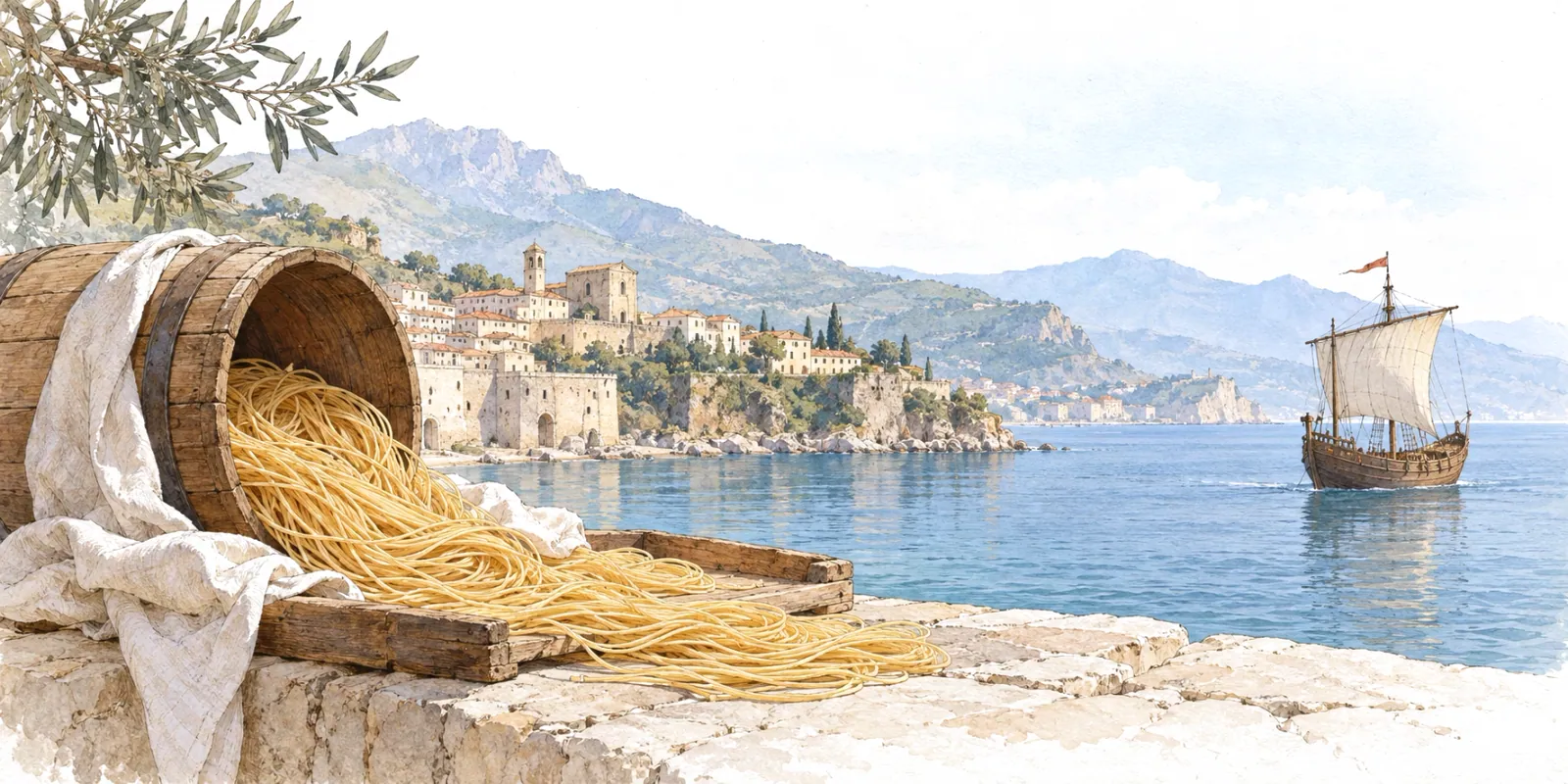
Non. On fabriquait et exportait des pâtes sèches en Sicile plus d'un siècle avant le retour de Marco Polo en 1295.
Ce récit n’existe qu’en anglais.
État éditorial: in-review
La légende
The story goes that the Venetian traveller returned from the court of Kublai Khan with noodles, and Italy learned to make pasta. It is charming, endlessly repeated, and contradicted by the documents.
Sources: [2]
Les preuves
In 1154 — a century before Marco Polo was born — the geographer al-Idrisi described Trabia in Sicily as a place where itriyya, a dried pasta that later sources describe as string-like, was made in such quantity that it was shipped across the sea to Calabria and other Muslim and Christian lands. A Genoese notarial inventory of 1279, listing the estate of a soldier, Ponzio Bastone, records a barrel of macaroni.
The one passage in Marco Polo's book usually cited is about Sumatra, not China: the sago "flour" from a palm tree, which in Ramusio's 1559 edition is said to be made into pasta "in strips and other forms". The food is described in terms of one already familiar in Italy, not presented as something new.
Historians of pasta such as Silvano Serventi and Françoise Sabban trace two separate traditions: Chinese noodles, with a very long history of their own, and a Mediterranean tradition of dried durum-wheat pasta with roots in the Greco-Roman and Arab worlds. Both are ancient; neither needed the other.
Sources: [3] [4] [2] pp. 45, 49 (Ponzio Bastone inventory, 1279); seen in search snippets only
D'où vient le mythe
The tale gained its popular form in the twentieth century; food historians commonly trace it to a 1929 article in The New Macaroni Journal, the trade magazine of the US macaroni manufacturers' association, which presented an embellished story of Marco Polo and noodles. It is a useful reminder for this atlas: an attractive story is not a source.
Sources
- From Marco Polo's spaghetti to risotto alla milanese: myths and fake news about food, Luca Cesari, Gambero Rosso International (2025) · verified
- Pasta: The Story of a Universal Food, Silvano Serventi & Françoise Sabban (Columbia University Press) (2002) · to-verify
- Marco Polo, Mark Cartwright, World History Encyclopedia (2019) · verified
- The Travels of Marco Polo, vol. 2 (Yule–Cordier translation), Book 3, chapter on Fansur, and note 4 quoting Ramusio, Henry Yule & Henri Cordier (Project Gutenberg eBook (1903) · verified
Rataterra · codex/takeover-20261028@d1a5d42186135017061ffc0199695ea73c9aad15 · Illustration : Rataterra